Kim Dacres Sculpts Resilience in Rubber
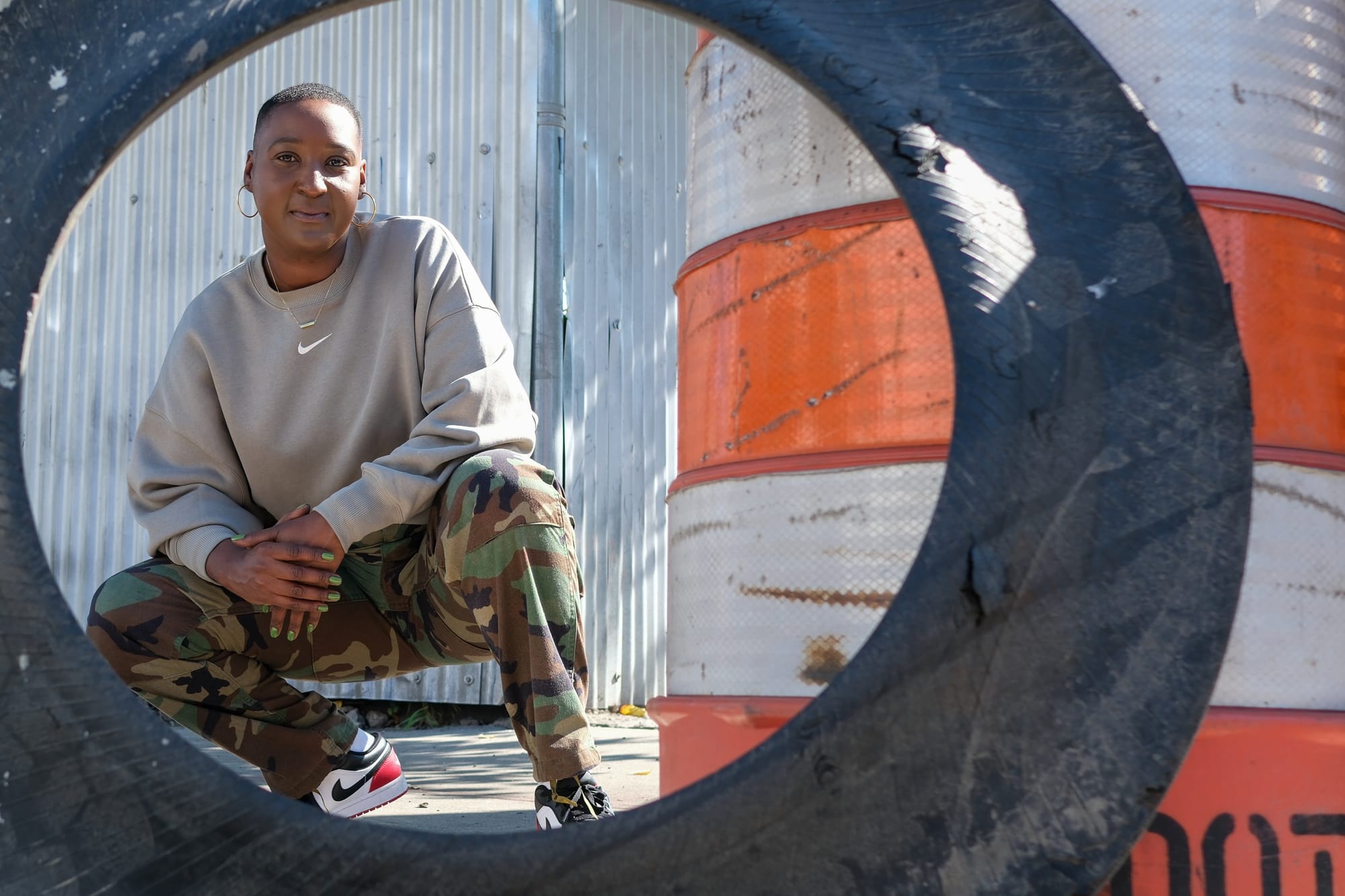
For Kim Dacres, every Tuesday morning unfolds in the same way. Each week, the native New Yorker and West Harlem resident journeys through her beloved neighborhood, scavenging for the materials that form the bedrock of her artistic practice: tires and bicycle parts. Last month, I joined the artist for what she calls “Tire Tuesday,” a ritual of collecting rubber that she transforms into busts and sculptures in tribute to her community. At our first stop, Bolt Bike Shop on Frederick Douglass Boulevard, we were greeted by Marcelo and Nelson, two shopkeepers whom the artist has developed a bond with since she began collecting there in 2021.
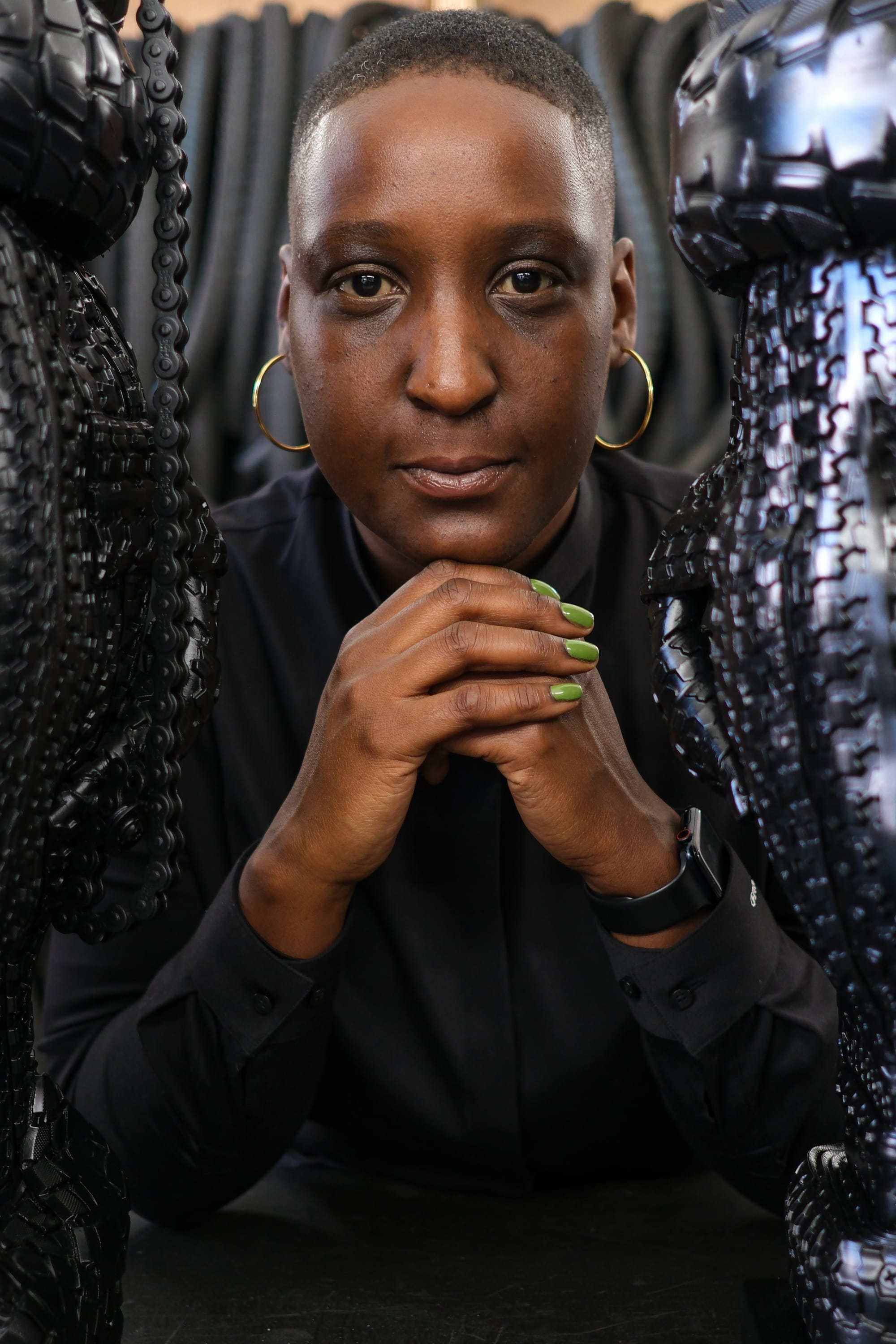
As Dacres excitedly received her weekly haul of found rubber, I watched the wheels of her brain begin to turn. Visits like these, which the artist began making in 2017, are as integral to her process as the time she spends working in her Harlem studio. Dacres’s current exhibition at Charles Moffett, Lost on a Two Way Street, exemplifies her distinct method of transforming her choice material into striking commentary on the United States’ongoing oppression of marginalized groups, particularly women and queer and immigrant communities.Through 18 sculptures and wall-based works made of rubber, valves, and other repurposed bike parts,the show expands on Dacres’s 2025 body of work, Crossroads Like This, which deals with the difficult emotions arising from violence, human rights abuses, and struggles for global liberation.
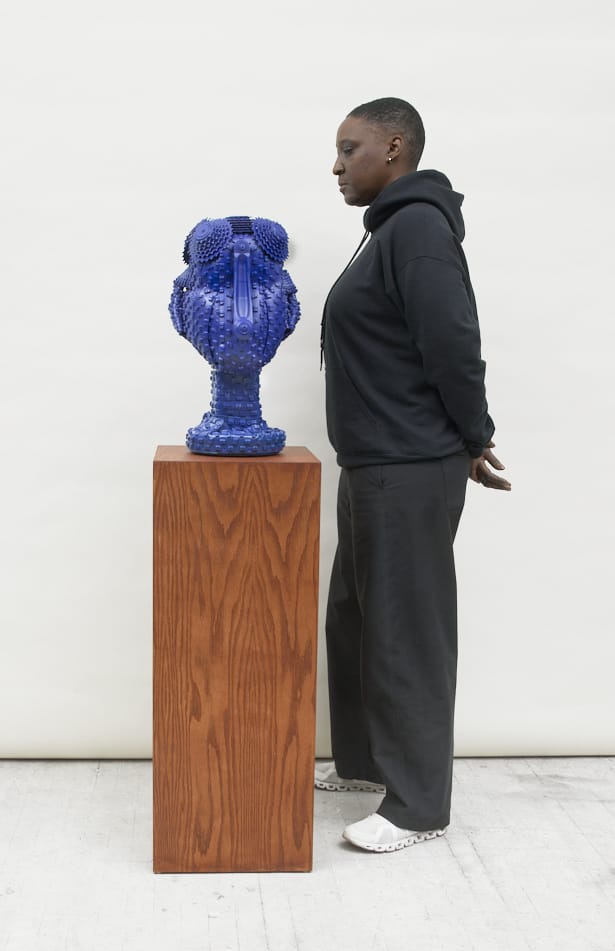
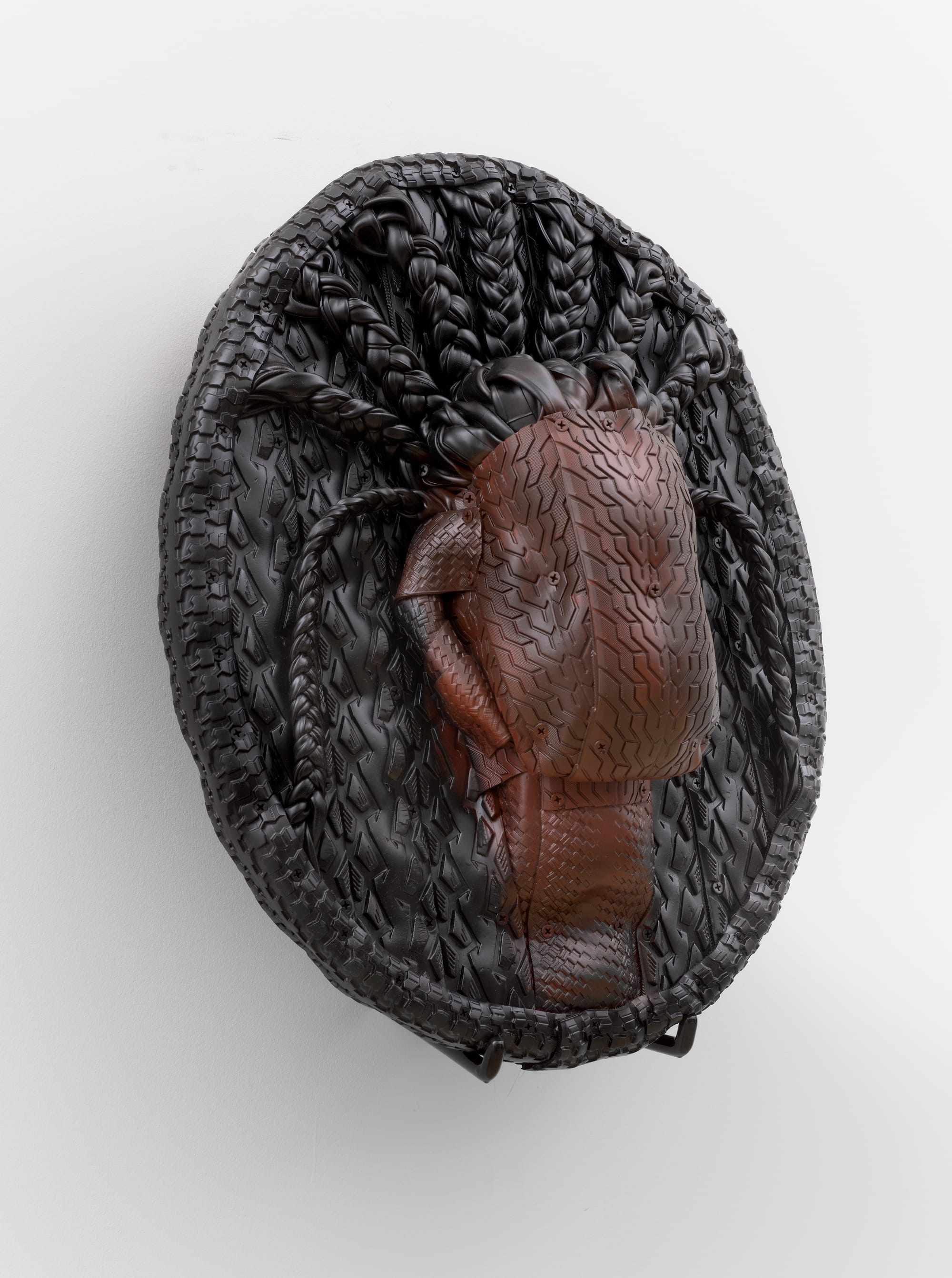
Left: Kim Dacres with "Until the ocean covers every mountain high (Blue Gears)" (2026); right: Kim Dacres, "Oval Medallion -Lady with Contained Crash out Braids" (2026), found auto and bicycle rubber, braided bicycle inner tubes, bicycle chains, wood, screws, black and red primer spray paint
Dacres’s fascination with found auto and bike parts is multifaceted. First is rubber’s ubiquitous nature — it’s used in various modes of transportation, footwear, and household items, to name a few — along with its resilience and ability to absorb trauma without much visible damage. Equally important is the olfactory experience it conjures. “It smells like home, like the city, like places I'm going,” Dacres, who was born and raised in the Bronx, shared. “It smells a lot like freedom and access to mobility.”
Indeed, Dacres is concerned not just with material, but how objects circulate among people and what they reveal about the emotional worlds they inhabit.
“A lot of times when I meet people, I think you can be flattened based off of what you do for a living, whether they consider you a pretty person or a rich person … and that's it. They ignore all the places that you’ve been,” the artist shared. “In my work, I try to make a [tribute] to somebody I've been inspired by. It could be somebody walking down the street, a musician, an athlete, anyone. But it considers the texture of the person and where they have been.”
The artist’s new series of wall-based works, titled Forget Me Nots (all works 2026) after Patrice Rushen’s 1982 classic song, illustrates this commitment to honoring her community members. These oval- and square-shaped works, which feature intricate braiding and a reddish-brown coating that deviates from Dacres’s typical all-black palette, nod to the crucial role that Dacres’s social bonds play in maintaining her mental health. Each medallion is culled from a memory of an individual that Dacres has seen while walking through her neighborhood, and for one reason or another, brought her joy. Titles like “Top Bun with Two Chains” (2026) represent the nicknames Dacres assigned to recall her mental snapshots, or “forget me nots.”
Everything from the exhibition title to new series and artwork names also pay homage to iconic Black musicians. The world felt heavy as the artist developed works for the show, and she turned to music, specifically her favorite love song —“As,” from Stevie Wonder's seminal 1976 album, Songs in the Key of Life— as a key point of departure for several central works. For example, “Until the ocean covers every mountain high (Blue Gears)," a sizable bust on a custom stained oak plinth, directly references Wonder’s poetic lyrics describing a cosmic, boundless love — like the love that Kim has for herself, and in turn, for her community.
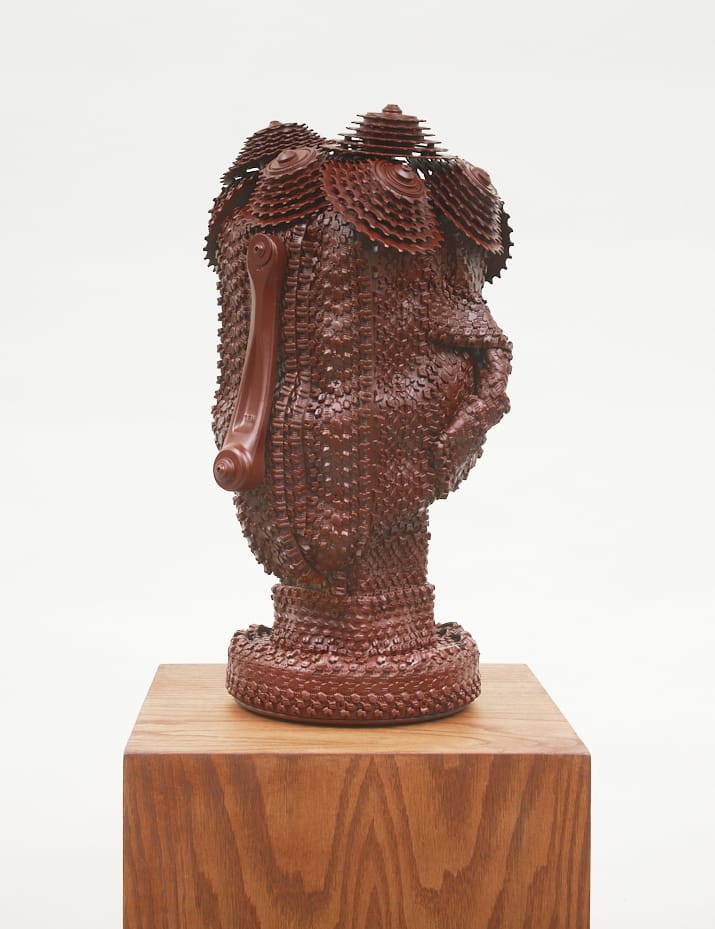
Recently, Dacres has shifted from individual people to larger concepts — not just love, but environmental disaster and attacks on LGBTQ+ rights. “(Blue Gears)”is noticeably vibrant in comparison to Dacres’s typical all-black sculptures. Created at a time when Hurricane Melissa was pummeling Jamaica, the artist ties the work to the reality of rising sea levels brought on by climate change through both the work’s appearance and its title. “Each idol is loosely dedicated to contemporary topics weighing on my spirit every morning,” Dacres says, including “The day is night and night becomes the day (Gears & Chains Headdress),” which epitomizes anxiety and depression, and “The rainbow burns the stars out in the sky (Brown Gears)” (2026), which takes on attacks on gender fluidity.
From tires and pedals to cranksets and cassettes, Dacres’s artistic practice has birthed a signature vocabulary that probes the capacity of material to carry and interpret difficult truths about our world, including barriers to education and access, concerns around citizenship, and threats against civil and human rights. As Dacres puts it, “We don’t just pop into a place. When you go somewhere, you are shaped by that environment.”
More From This Topic
View Topic
Trump calls Brazil 'politically difficult'; Lula says he should learn about 'civilized elections'
Brazilian President Luiz Inácio Lula da Silva on Wednesday asked his US counterpart, Donald Trump, n …

How to Scale Laravel Applications for High
June 11, 2026 / #L …

Backend Challenges Teams Face When Processing Repeat Payments
June 4, 2026 / #ba …
![Command Line for Beginners – How to Use the Terminal Like a Pro [Full Handbook]](https://cdn.hashnode.com/res/hashnode/image/upload/v1725624619864/093d60f5-5412-4e63-af0b-38a8bebe93a8.jpeg?w=500&h=500&fit=crop&crop=entropy&auto=compress,format&format=webp)
Command Line for Beginners – How to Use the Terminal Like a Pro [Full Handbook]
April 5, 2022 / #B …
South Australia premier says youth social media ban is working, 6 months later
Six months after Australia implemented the world's first-ever social media ban for kids under 16, So …

Learn TypeScript – A Handbook for Developers
February 7, 2025 / …